
There is a campaign in our Meta ad account that spent €35.61 over ninety days. We thought it had been switched off months ago. On the evening of 2 August we asked Claude to read the account, and it came back ACTIVE.
Nothing dramatic happened. It was a small boosted post, it was not draining a budget, and it is paused now. What matters is the shape of the problem: the number existed, nobody was looking at it, and out of the box Claude had no way to look at it either. That’s the gap at the centre of this piece — Claude marketing data connectors barely exist for the platforms that actually hold your ad spend. Claude does not reach a Meta ad account, a Google Ads account or Google Analytics by default. Not from the connector directory, and not without going out and adding something yourself.
This is not a setup guide. We already wrote that one, and if you want the step-by-step it lives in our Windsor.ai MCP walkthrough. This article answers three different questions: what is actually missing from Claude’s connector directory, why the gap that matters is structural rather than temporary, and what genuinely changes — including what breaks — when you put a bridge in the middle.
Disclosure: Some links in this guide are affiliate links. If you start a plan through one of them, we may earn a commission at no extra cost to you. No vendor sees or approves our guides before they go live.
We should say this early, because it changes how you read the rest: we use one of the bridges in this article, Windsor.ai — we’re moving onto its paid plan this month — and we are in their affiliate programme. This article contains four specific criticisms of their product, all of them from our own account. One of them we have since narrowed, because a later measurement moved part of it upstream, off Windsor and onto Meta’s own reporting endpoint — the dated note further down sets out what was measured there and what is inferred. None of them has been removed.
What we searched for, and what came back
Method first, result second — which is the opposite of how this usually gets written, and the reason you can check us.
On 2 August 2026 we ran four separate searches against Claude’s connector registry, deliberately overlapping so that a bad query in one wouldn’t hide a result in another:
- Advertising in general — ads, advertising, ad platforms
- Meta specifically — Meta, Facebook, Instagram
- Web analytics — Google Analytics, Search Console
- Everything else that distributes — TikTok, LinkedIn, YouTube, Pinterest
Across all four, not a single native connector for an individual advertising platform or web analytics product came back. Not Meta. Not Google Ads. Not GA4. Not TikTok Ads, LinkedIn Ads, or Search Console.
What did come back, in every query, was the same three names — and all three are aggregators. Not the platform itself, but a service that sits between you and the platform: Windsor.ai, Supermetrics, and Coupler.io.
Now the limit of that method, before you quote it anywhere. The registry returns the top ten results by relevance, not an exhaustive index. That means presence is proven and absence is not. We can tell you with certainty that those three aggregators are there. We cannot tell you with certainty that a native Meta connector does not exist somewhere below the tenth result of every query we tried. If you find one, we want to know, and we will update this page with the date.
That caveat is not modesty. It is the difference between a measurement and a claim, and this article is going to lean on that distinction several more times.
The contrast is what makes the result readable. Shopify has an official connector. Stripe has one. Canva has one. Notion, Slack, Gmail, Google Drive, Google Calendar — all there, all first-party. The directory is not thin. It is thin in one specific place, and that place is where your marketing numbers live.
Added 5 August 2026 — we found one, and it was not in the registry. Two days after publishing, we went looking outside Claude’s directory and found Meta’s own. Meta Ads AI Connectors launched in open beta on 29 April 2026: a hosted MCP server at mcp.facebook.com/ads, added to Claude as a custom connector by URL, authenticated through ordinary Meta Business OAuth — Meta’s own language for that path is “no developer credentials, API setup, or coding required.” A separate developer-app door exists too, added in July, and that one does ask for an app ID; agencies managing an account on someone else’s behalf go through a review Meta calls advanced access. It reads and writes, and it’s free during the beta with no long-term pricing announced — though we haven’t found that written down on any Meta page ourselves, so treat it as circulating rather than documented. It never surfaced in our four searches because it is not in the directory those searches read.
The caveat above held, which is the only comfort available here: presence proven, absence not. The measurement stands — nothing native came back from the registry — but the section that followed it did not, because it argued that the platforms had no commercial reason to build this, and one of them had already built it four months earlier. That section is rewritten below. We have not tested Meta’s connector; everything in this paragraph is read off Meta’s own launch material and documentation, cross-checked against several independent write-ups, on 5 August 2026.
Added 11 August 2026 — the tool count above was wrong, and so was everyone else’s. The first version of this paragraph said Meta’s connector exposes twenty-nine tools, following every other guide to it we found. We went back and counted Meta’s own documentation instead of repeating the consensus: seven category pages, 91 distinct tool names, only eight per cent of them reporting — the largest single category, by far, is product catalog and commerce management, not campaigns. The full count, the write-tool breakdown, and what it changes about who this connector is actually for is its own piece: Meta Ads MCP: Everyone Says 29 Tools. We Counted 91. Still true from the paragraph above: we have not connected this server ourselves.
Why the gap is structural — and what the platforms are actually building
The comfortable reading is that ad platforms simply haven’t got around to it yet, and that native connectors are six months away. That reading is wrong, but not in the direction we first thought. Two of the largest platforms have already shipped, and what they built tells you more than the absence ever did.
Meta shipped a write surface, and gave it away. No developer credentials, no app review, no coding — you paste a URL into Claude, you log in with the Business account you already have, and within minutes an assistant can pull performance breakdowns, create campaigns, ad sets and ads, edit budgets and targeting, and troubleshoot a product catalogue. It is free while the beta lasts. That is not a company reluctantly opening a door. That is a company removing every obstacle between you and the act of launching an ad.
Google shipped the opposite, and the contrast is the whole argument. Google Ads also has an official MCP server, and it is nothing like Meta’s. You deploy it yourself on Google Cloud Run, you wire it into your client’s config file, and Google’s own developer documentation states plainly that the implementation is strictly read-only: it cannot change bids, it cannot pause campaigns, it cannot create assets. It is a tool for a developer who wants to query reporting data programmatically. It is not a front door for the person running the account.
The regularity, and this part is reasoning rather than measurement. Meta hands you write access for nothing, with zero setup, on the operations that end in spend. Google hands you reading, gated behind a deployment that almost no marketer will perform. Neither of them hands you the one thing you actually asked for, which is a single question answered across every channel at once. A native connector is built to make you more effective inside one garden. Nobody has a commercial reason to build the view between gardens, because that view is where you discover that one of the gardens isn’t working.
What that costs you in practice. Native means one platform per connector: four channels is four connectors, four OAuth flows, four separate mental models, and still no query that spans them. And there is a ceiling that has nothing to do with any vendor — Claude’s free tier holds one custom connector at a time. Two ad platforms connected natively is already impossible there, before you have spent a euro on anything.
The precedent that isn’t speculation, reread correctly. X had programmatic access and then decided what it was worth. The free API tier closed to new developers in February 2026. In April 2026, publishing was repriced: roughly $0.015 for a normal post, and $0.20 for a post containing a link — thirteen times more, aimed squarely at exactly the automation most creators would build. The legacy $200 Basic tier was closed to new subscribers and its existing ones migrated from 1 June 2026. That is documented across five independent sources. The lesson is not that platforms close access. It is that they price it by what it feeds: cheap or free where it drives spend on their own inventory, expensive where it drives distribution away from it.
One line on the obvious question: this is not a Claude limitation. ChatGPT has the same hole, for the same reasons, and so does every other assistant — the constraint sits with the platforms, not with the model. That deserves its own article and it is in our pipeline; here it deserves one sentence, and this was it.
The three bridges
A bridge is a service that holds the credentials for the platforms on your behalf and exposes all of them to Claude as a single connector. You authorise Meta, GA4 and the rest once, inside the bridge; Claude talks only to the bridge.
| Bridge | What it is | Our position |
|---|---|---|
| Windsor.ai | Aggregator with a wide source catalogue, in the official directory, read and write. | Our own account since July 2026, moving onto the paid plan this month. Everything that follows comes from it. |
| Supermetrics | The incumbent in marketing data plumbing, long-established, with an MCP connector. | Covered separately in our Supermetrics Studio write-up. Subscription under review at the time of writing. |
| Coupler.io | Aggregator, four tools exposed over MCP. | Never tested by us. We found it during this census and we are naming it because it exists, not because we can vouch for it. |
You will notice there are no prices in that table. That is deliberate. A head-to-head on cost is a real article and it deserves to be one — with every number read off the vendors’ own live pages on the same day, which is the only way that comparison is worth anything. Doing it in three lines here, while we hold an affiliate relationship with one of the three, would produce a comparison you’d be right not to trust. We’ve since written it: Windsor.ai vs Supermetrics for Claude, paying for both accounts ourselves to get numbers neither vendor’s own page would hand us.
What is worth saying about all three at once is the thing none of their marketing pages leads with. A bridge is an intermediary that sees everything. Your platform credentials live with them. Your traffic, revenue and audience numbers pass through them. Their uptime becomes your uptime, and their security posture becomes part of yours. That is not an accusation — it is the structural cost of the arrangement, it applies equally to all three, and it is the first thing to weigh rather than the last.
Added 3 August 2026. Within hours of publishing this, two more bridges surfaced — neither of them through the registry. Porter Metrics runs a Claude connector page advertising more than twenty-five marketing sources, and says it queries each source’s API directly rather than serving from a cache. Adzviser is smaller and narrower: Google Ads and Meta Ads, around $49 a month. We have tested neither, and we have not verified how either one installs — most likely as custom connectors added by URL, which is exactly the territory a directory search cannot see into. We are adding them because we said we would, and because they demonstrate the caveat above better than the caveat does: the honest sentence is “three came back from the registry”, not “three exist”.
What actually happens once the bridge is open
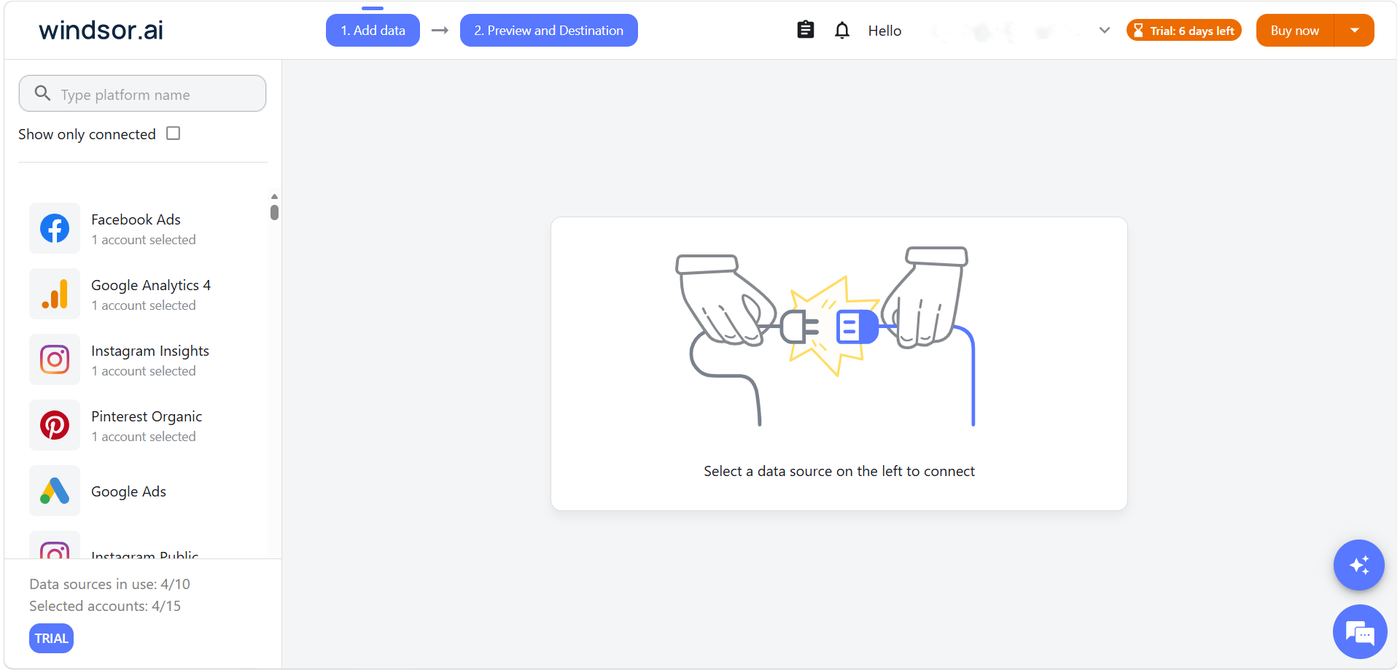
We connected four sources during the trial: Google Analytics 4 for site traffic, Instagram Insights for reach and saves, Pinterest Organic for a channel we were still evaluating, and Facebook Ads for the boosted posts. Four sources, four accounts, verified in our own account on 3 August 2026.
Here is the first thing nobody tells you at signup. The trial holds ten sources. The permanent free plan that follows holds one. The paid Basic plan holds three. We had four. So the arithmetic of moving off the trial is not “do I pay” — it is “which source do I drop”, and that question arrives on day thirty-one whether or not you have thought about it. Basic was $23 a month, or $19 a month on an annual commitment, when we checked on 24 July 2026. We ran the full head-to-head against Supermetrics separately, with both invoices in hand — see Windsor.ai vs Supermetrics for Claude.
We are dropping Facebook Ads. The reasoning is that it was the only source we were effectively paying to read twice, and Ads Manager reads it natively for free. It is the right call and there is an irony in it worth admitting: the source we are about to disconnect is the one that produced the sharpest finding in this article. We published the measurement first and are disconnecting afterwards, in that order, on purpose.
Authorising is not connecting
This one cost us an evening, and it is the single most useful paragraph here for anyone who actually installs a bridge.
On Pinterest, the OAuth flow succeeded. The token was saved. The popup closed. And the account was not connected — because the popup closes before the panel where you tick the account you want, and that panel is where the connection is actually made. There was no error message. Nothing anywhere said “not finished”.
The only reliable check is the source counter at the bottom left of the panel. If the number doesn’t go up, it didn’t happen. Authorising a platform and connecting a source are two different events, and only one of them announces itself.
The write actions toggle, and where it lives
Windsor’s connector can do a great deal more than read. On 7 August 2026 we counted the write actions it exposes for Meta: seventeen. Pausing and enabling campaigns, ad sets and individual ads. Setting campaign and ad set budgets. Creating campaigns, ad sets and ads from scratch. Boosting an existing organic post. Rewriting the copy, headline, image, destination link and call-to-action button of an ad that is already running. We counted them in the connector’s own action list; the only one we have ever run is the pause described further down.
That number matters because it sets the size of what the switch guards. This is not a toggle deciding whether an assistant may pause something. It is a toggle deciding whether an assistant may publish an advert.
Updated 7 August 2026: this section originally described that surface as pausing, enabling and budget-setting. That was an undercount, and it made the switch sound smaller than it is.
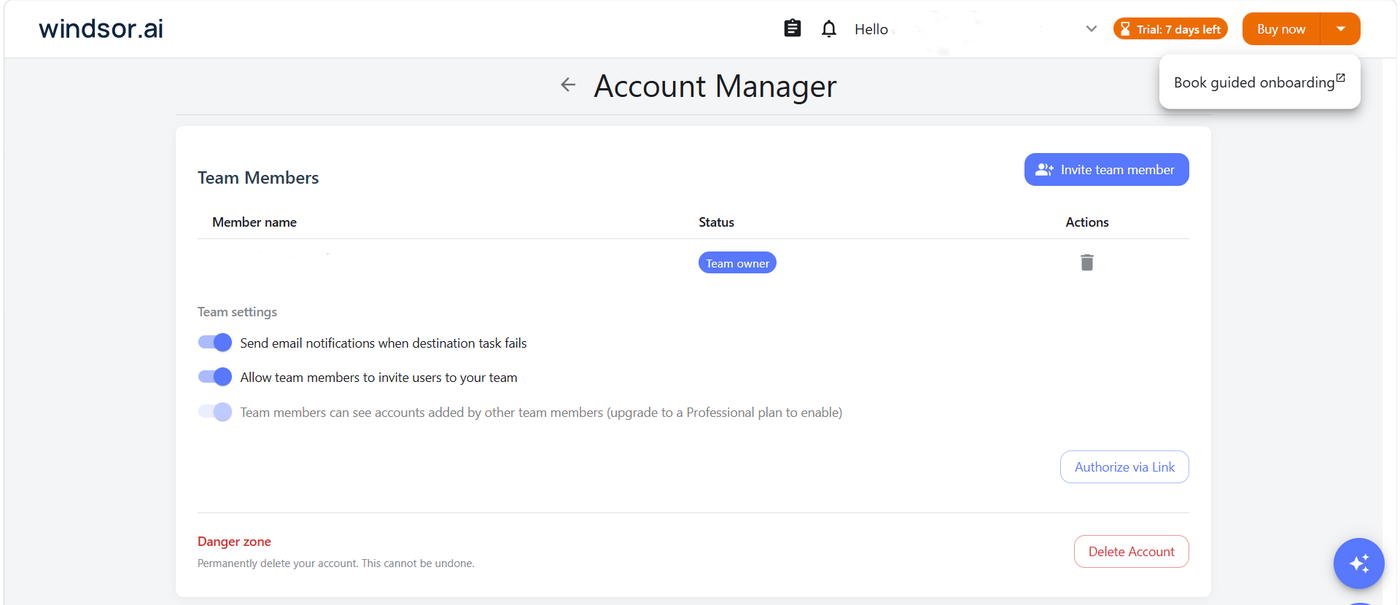
That capability ships switched off. It is controlled by a toggle called “Enable write actions via API”, and it lives at onboard.windsor.ai/app/team-management, in the API Access section, underneath the API key.
Credit where it is due, because this matters: the explanation attached to that toggle is genuinely good. It names MCP explicitly, it gives concrete examples of what write access allows, it states plainly that the setting applies across the whole account, and it tells you that switching it back off returns everything to read-only. Whoever wrote it understood that a user needs to know the blast radius before flipping a switch. We have seen far worse from far bigger products.
The explanation is excellent. The location is not. Nobody connecting Windsor to Claude passes through team management — you go to the source panel, you authorise, you go back to Claude. And the marketing is running ahead of the onboarding: the company’s own social channels promote read-and-write, “post to Instagram right from Claude”, while the feature arrives disabled and the switch sits on a page the setup flow never shows you. The predictable outcome is a user concluding the connector is broken when it is doing precisely what it was configured to do.
Two more notes on that page. The toggle is a single global lever — all write actions, all connected sources, on or off. Compare that with Make’s consent model, which offers nine entity types across view, modify and run permissions. These are two philosophies, not a winner and a loser: the global lever is comprehensible in ten seconds and gives you no granularity, the permission matrix gives you granularity and almost nobody reads it. Pick according to how much you trust yourself to read a matrix.
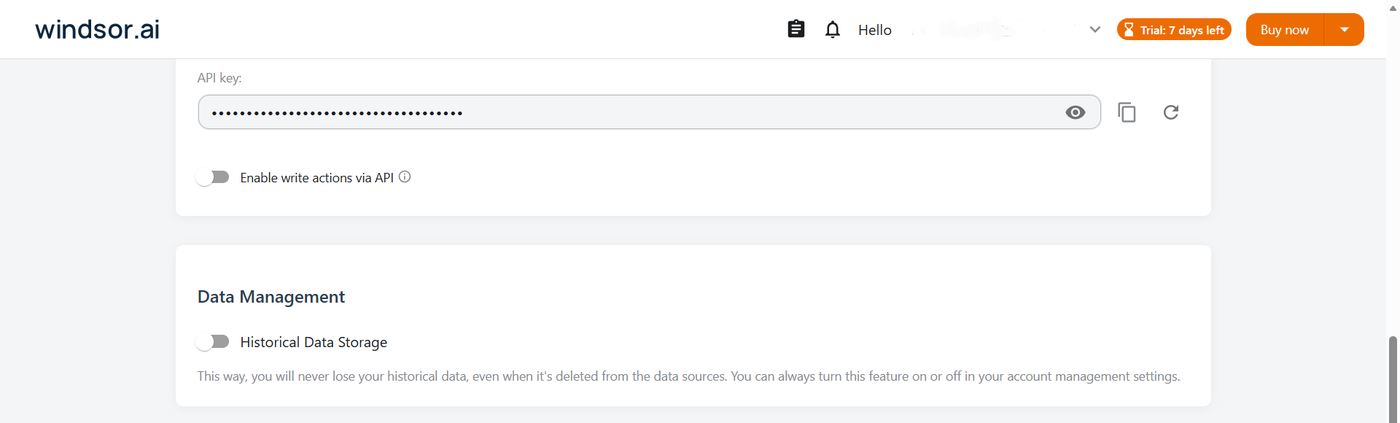
And Historical Data Storage is also off by default, on the same page. Given that the free plan retains thirty days of history, that is a setting worth understanding before you assume you have a backlog. We have not tested whether enabling it changes what you are charged, so we are not going to tell you that it doesn’t.
Four things we found in one evening
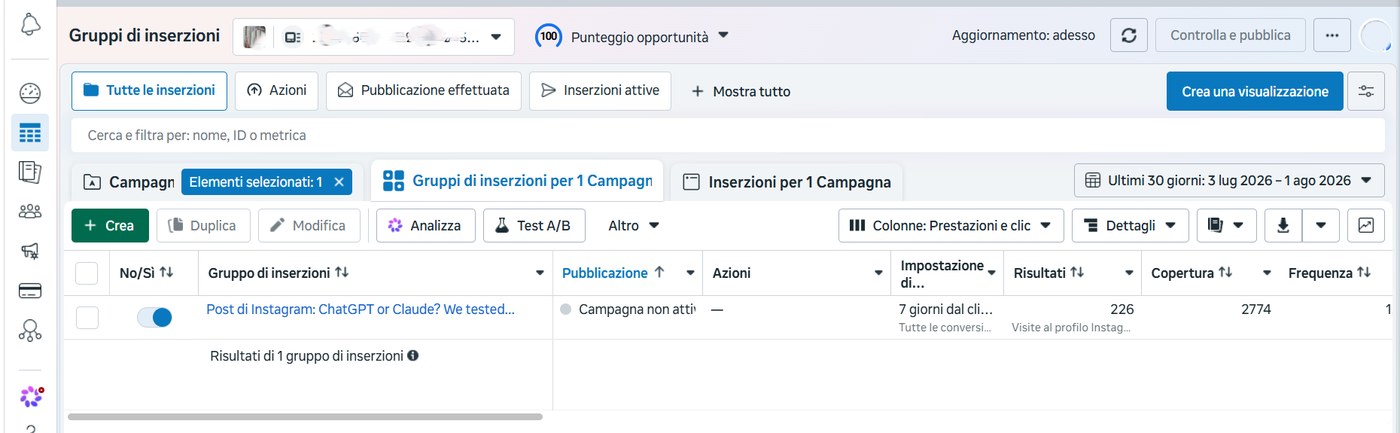
Everything in this section was measured in our own account on the evening of 2 August 2026, on campaign 120249553695340183 — the boosted Instagram post mentioned at the top, €35.61 spent over ninety days, believed closed, found active.
The sequence, in order:
- We asked Claude to pause the campaign. It refused — write actions were off, correctly.
- We enabled the toggle in team management.
- We asked again. Claude called
pause_campaignand reported success. - We asked Claude to re-read the campaign. It came back ACTIVE.
- We opened Ads Manager. The campaign was paused.
1. Writes are instant, reads are six hours stale
The write went straight through to Meta. The read came out of a cache with a six-hour refresh. Both behaved exactly as designed, and together they produce a genuinely awkward property: the assistant cannot verify its own action through the same connector it used to perform it.
On a pause, that is harmless. The dangerous version is the loop it invites — execute, fail to see the effect, execute again — on something like setting a budget, where running the same instruction twice is not idempotent in any way you’d enjoy.
The rule that falls out of this is short enough to remember: the source of truth for a write is the native platform, never the bridge.
2. The read returned one campaign out of thirty-eight
This is the hardest finding in the article and we are not going to soften it. Asked to list the campaigns in the account, get_data returned one. The account contains thirty-eight. Widening the date range to two years changed nothing.
The behaviour is explicable — the endpoint returns campaigns with delivery data in the requested window, not campaigns that exist — and once you know that, it is consistent. But nothing in the response says so. There is no note, no count, no “37 campaigns had no delivery data in this period”. A plain-language question produces a confident, well-formatted, incomplete answer, and the incompleteness is invisible.
If you are going to ask an assistant what is running in your ad account, know that this is the failure mode: not a wrong number, an absent one.
Added 7 August 2026 — we put the same question to a second bridge, and it moved where the fault sits. We pointed Supermetrics’ MCP connector at the same Meta account, over the same two-year window. Its reporting query returned the same single campaign, the same €35.61, the same ID. Then we asked that connector for the campaign list through its campaign-management call instead of its reporting call, and it returned all thirty-eight — IDs, budgets and dates, going back to 2019.
So the filter is not Windsor’s invention. It belongs to the reporting endpoint, which answers with the campaigns that had delivery in the window you asked about, and any bridge reading that endpoint inherits it. The complete list exists, and it is one different call away — for a bridge that offers that call. What survives is a narrower criticism, and a better-founded one: Windsor’s Meta surface exposes seventeen write actions, and the only path to campaign data is get_data, which reads the filtered endpoint. On this bridge the incomplete answer is not merely unannounced. It is the only answer available.
The advice above is unchanged, and so is the warning. If you ask an assistant what is in your ad account, the failure mode is an absent row rather than a wrong one — and knowing whose filter it is doesn’t put the missing thirty-seven back on your screen.
Register, since we ask you to check ours: both Supermetrics readings and the count of Windsor’s exposed actions were made in our own accounts on 7 August 2026. That the filter originates in Meta’s reporting API rather than in either bridge is an inference from those readings, not something we read in Meta’s documentation.
3. The asymmetry (reasoned, not tested)
Put those two findings together and something follows. Reads are filtered and cached. Writes take an ID and go straight to Meta’s API. Which implies that a campaign ID is sufficient to act on a campaign the connector will not show you.
We did not test this. The campaign we acted on was one the read returned. We are stating it as an inference from mechanics we observed, and we are labelling it as such rather than dressing it up. It is the kind of thing that would be worth a vendor confirming or denying, and if Windsor tells us we’re wrong we will say so here.
4. “Pause the campaign” pauses the campaign, and only the campaign
pause_campaign operates at campaign level. The ad set underneath stays enabled. Re-enable the campaign and delivery resumes immediately, because nothing below it was ever stopped.
That is not a bug — it is the level the API operates at, and it is correct. But someone telling an assistant “turn this off” in plain English is describing an outcome, and what they get is an operation. The two are not the same shape, and the gap between them is where automation accidents live.
The counterweight, because it is owed
The write worked on the first attempt. No error, no retry, no partial state. Ads Manager showed the campaign paused, exactly as instructed, within seconds. The problem in this section is not that the feature doesn’t work. It is that you cannot confirm it worked from the place you launched it — which is a different criticism, and a fairer one.
If you’re going to open a bridge anyway
We are, so this is not a warning label. It is the checklist we wish we’d had on day one.
- Check the source counter after every authorisation. A closed popup is not a connected account.
- Count the sources you actually need against what the plan holds after the trial. Ten during, one after, three on the cheapest paid tier. Do that arithmetic on day one, not day thirty-one.
- Leave write actions off until you need them, then switch them off again. It’s one toggle in both directions, and it governs creating and editing ads, not only pausing them.
- Never ask the assistant to confirm its own write through the same connector. Open the platform.
- Check what level a command acts on before trusting the word “pause”.
- Treat a list as a report, not an inventory. A reporting query answers with what had delivery in your window. If you need to know what exists, find out whether your bridge has a second call that asks that question — and if it doesn’t, the platform’s own interface is the only complete answer.
- Watch for sources that are free inside the bridge and metered underneath it. Windsor’s X Organic source looks like one more row in a plan you’ve already bought; connecting it asks for your own X developer credentials, which puts you on X’s pay-per-use meter — the one with the $0.20 link posts. The bridge isn’t hiding that, but it isn’t the shape the source list suggests either.
- Check whether the platform you care about has shipped its own connector first. If Meta is the only channel you run, Meta’s own server is free during its beta, writes as well as reads, and puts no intermediary between you and your credentials. A bridge earns its place when you have more than one channel to compare — not automatically.
If a bridge is the right answer for you, Windsor.ai is the one we’re paying for from this month, with the four caveats above attached and not detachable. If your reporting lives in Looker Studio or spreadsheets, or you’re operating at agency volumes, look at Supermetrics before you decide — we ran that comparison in Windsor.ai vs Supermetrics for Claude.
What this actually tells you
The hole in Claude’s directory is real, and it is exactly where your marketing data lives. What we got wrong on 3 August was the prediction we hung on it: we said we didn’t expect the platforms to fill it, and Meta had already started four months earlier. The correction is smaller than it sounds and more useful than the original claim. Platforms will build the connector that makes you more effective inside their own product — Meta gave write access away for free; Google shipped a read-only server you have to deploy yourself. What none of them is building is the view across platforms, and X spent 2026 demonstrating that programmatic access gets priced by what it feeds rather than handed over as a courtesy.
Bridges close that gap, and they close it well enough that we found a live campaign we’d forgotten about. They also introduce an intermediary that holds your credentials, a cache that lies about the present tense, and a read path that can return one row where thirty-eight exist without telling you.
None of that is a reason not to use one. It is a reason to know which register each thing you’re told belongs to — measured, documented, or inferred — before you build a workflow on top of it. Including everything on this page.
The Claude MCP Playbook
One comparable page per connector: what it does, what it actually costs, how many minutes the setup takes, and the trap nobody mentions — plus ready-made stacks for four kinds of business. In progress.
Founding price is $19 for the first readers on the list. Join the waitlist here.
You Might Also Like
More from our testing on connectors, costs and what vendors don’t put on the pricing page.
Related Posts